
How cloud-enabled access became Thailand's quantum fast track
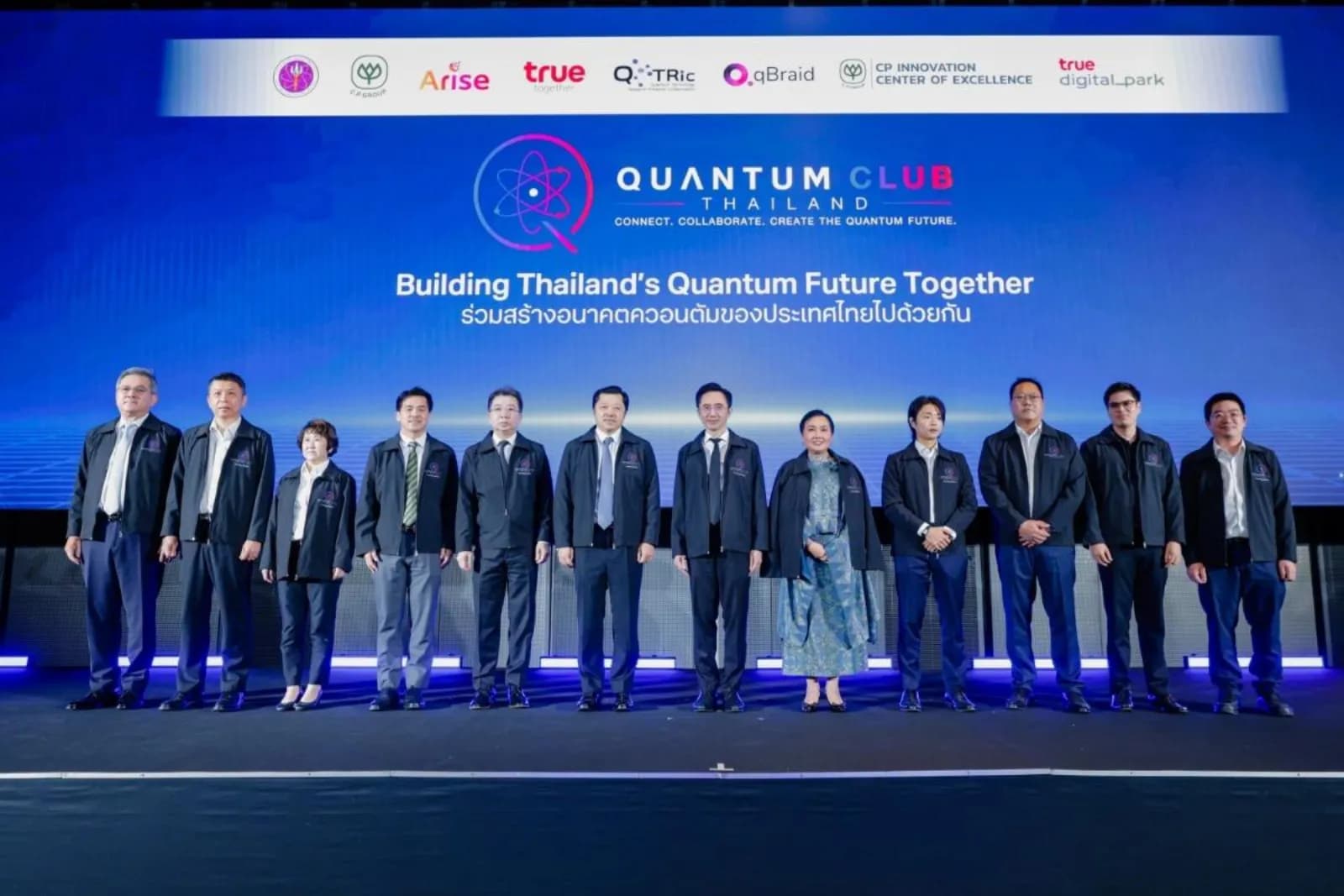
Founding members of Quantum Club Thailand on stage at True Digital Park, Bangkok, August 3, 2026. (Photo: True Corporation)
qBraid is proud to co-found Quantum Club Thailand to translate national ambition into day-one access to leading quantum systems—while building the workforce, applications, and optionality needed for long-term competitiveness.
On August 3, 2026, Thailand's Deputy Prime Minister and Minister of Higher Education, Science, Research and Innovation, Prof. Dr. Yodchanan Wongsawat, joined Suphachai Chearavanont, Senior Vice Chairman of Charoen Pokphand Group and Chairman of True Corporation, at True Digital Park in Bangkok to launch Quantum Club Thailand. The national platform brings together the ministry, CP Group, Arise, True, the Quantum Technology Research Initiative Consortium (QTRiC), and qBraid.
A national quantum strategy can look ambitious on paper, but it creates value only when researchers, companies, and students can use the technology to build skills and solve real problems. With qBraid, the ambition became practical at the launch and participants received immediate access to commercially available quantum systems, giving Quantum Club Thailand a working platform from day one.
The opportunity: Moving from strategy to practical access
Six weeks earlier, on June 24, Thailand's policy council approved the National Quantum Economy Strategy at a meeting chaired by the Deputy Prime Minister. Its four pillars—industrial applications, cybersecurity, workforce development, and, over time, domestic hardware capability—set a broad ambition. The immediate challenge was execution: how could Thailand begin building talent and industry use cases without waiting years and investing billions of baht in a single machine? The country's "apply, don't build" approach answered that question with cloud-first access, creating a foundation of skills and evidence to inform later hardware decisions.
Tech Times captured the shift in its headline, "Thailand Skips Quantum Hardware to Build ASEAN's Biggest Cloud Access Hub." On stage, the Deputy Prime Minister put the priority plainly: "The most important priority is to accelerate talent development in parallel with the transition from research towards real-world industry applications."
That priority is what the qBraid platform is designed to serve. With one qBraid account, Quantum Club members can access more than 26 quantum systems worldwide; available resources include hardware from IonQ, QuEra, Rigetti, Pasqal, IQM, and AQT, as well as NVIDIA GPU clusters for hybrid quantum-AI workloads.
AT A GLANCE | 26+ quantum systems through one login · 120+ researchers across 19 QTRiC institutions · 80+ Thai quantum prototypes · Day-one access for launch participants
The solution: Building access without locking in
For a country building capability in a fast-moving field, the case for cloud access begins with speed, flexibility, and cost. Buying a quantum computer can require tens of millions of dollars, and installed technology can begin aging immediately. Cloud access costs a fraction of what ownership does, gives users access to new processors as providers upgrade their systems, and avoids tying a national program to one vendor or technology roadmap. This flexibility helps Thailand build capability now while preserving its choices for later.
"Quantum technology will be one of the key technologies transforming the world and many industries in the future. If Thailand seeks to build long-term competitiveness, the country should not merely be a buyer or user of technology, but must begin today to jointly develop its own knowledge, talent, and innovation," says Ekaraj Panjavinin, Chief Digital Officer at True Corporation. True Corporation sees Quantum Club Thailand as an execution platform that connects frontier research with business challenges. Its goals include practical skills, applied research, industry pilots, and Thai deep-tech start-ups, supported by workshops, seminars, and international collaboration.
Alongside hardware access, qBraid's software reduces the friction of working across a fragmented provider landscape. Programs written with the qBraid SDK can run on any gate-based device on the platform, while built-in transpilation and circuit compression help teams make more effective use of each system. "The qBraid SDK gives users open-source tools to focus on what they want to build instead of which framework they need to master," says Harshit Gupta of qBraid's Quantum Software team.
That portability also changes how capability is built. Students learn skills that transfer across the industry rather than a single vendor's toolchain, universities can benchmark dozens of machines without managing dozens of contracts, and Thai start-ups gain a broader set of systems on which to test and scale ideas.
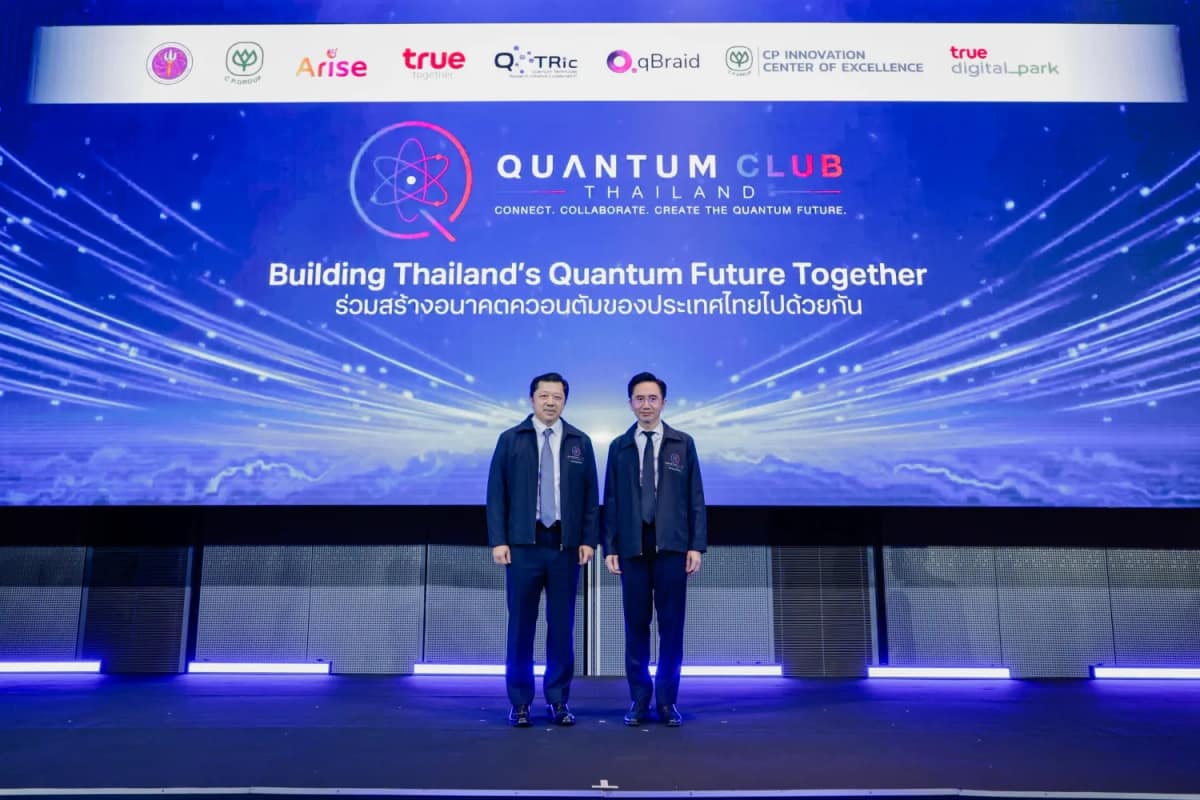
Deputy Prime Minister Prof. Dr. Yodchanan Wongsawat and Suphachai Chearavanont, Senior Vice Chairman of CP Group and Chairman of True Corporation, at the Quantum Club Thailand launch. (Photo: True Corporation)
"Our long-term objective is to position Thailand as ASEAN's quantum hub," says Suphachai Chearavanont, Senior Vice Chairman of CP Group and Chairman of True Corporation, at the launch ceremony.
The execution: Turning strategy into a working platform
The launch formalized work already under way. On June 17, True Corporation, QTRiC, and qBraid signed Thailand's first memorandum of understanding focused on quantum-enabled industry applications and secure, intelligent infrastructure. Quantum Club Thailand now advances that agenda through three flagship programs: Quantum Academy Thailand for workforce development, a Quantum Industry Lab that begins with telecommunications use cases, and a Quantum Innovation Challenge designed to turn ideas into ventures.
The launch moved from announcement to execution with a live demonstration. Using qBraid Lab in a browser, the team took real network data from Watthana—the district around the venue—and translated thousands of cell sites into a spectrum-sharing problem mapped to the atomic geometry of QuEra's 256-atom Aquila processor in Boston. The same notebook can be opened in any browser, allowing a student in Thailand to run the experiment on the same hardware.
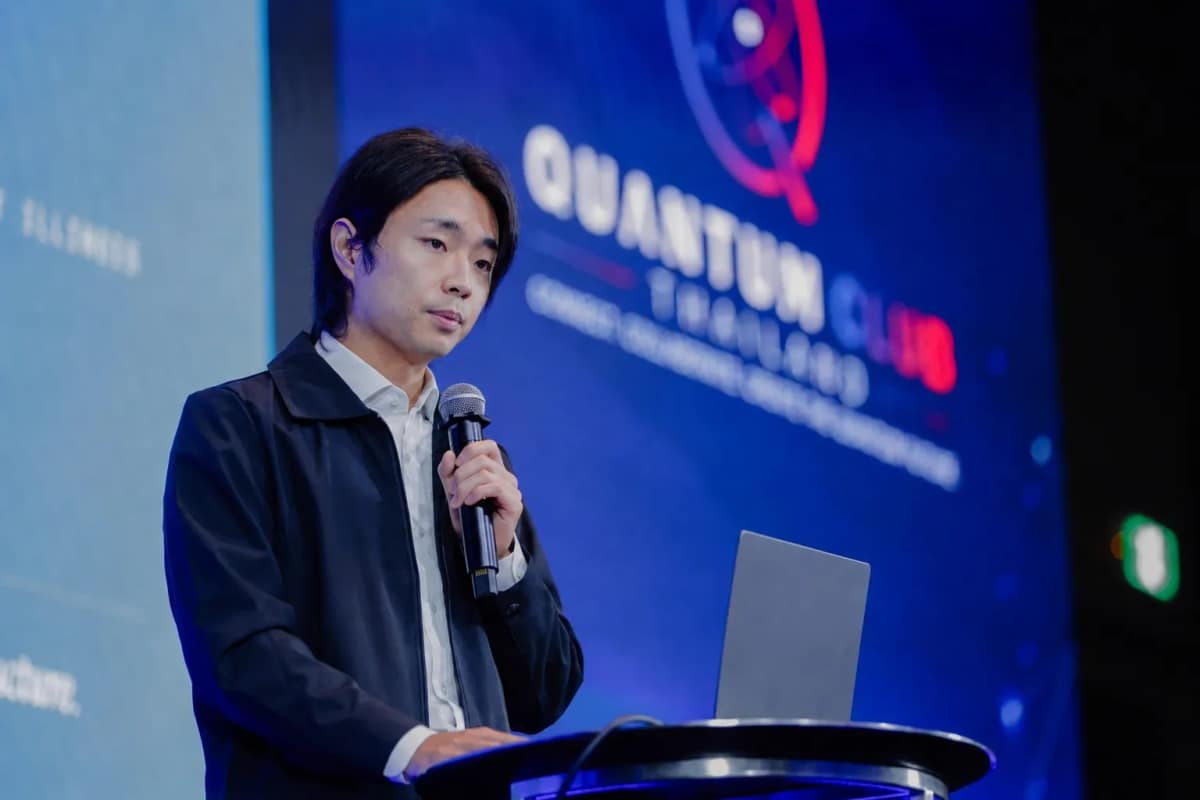
qBraid COO Ricky Young presents the live quantum demonstration at the Quantum Club Thailand launch. (Photo: True Corporation)
The path forward: A model designed to scale
Thailand is the latest national deployment of a model qBraid is helping scale globally. In Denmark, qBraid supports workforce development for QuNorth, the ecosystem forming around Magne, the Microsoft and Atom Computing system at the error-corrected frontier. In the United States, qBraid is a coalition member of Illinois's Bloch Tech Hub, part of the state's half-billion-dollar quantum campus. Across four continents, more than 400 institutions use the platform, including 40 universities participating in the QUEST hardware-access program. Thailand's launch shows how quickly a national capability can take shape when government, industry, and research institutions move together.
For hardware providers, the platform acts as a distribution channel: a system connected to qBraid can become available to hundreds of institutions across dozens of countries. For Thailand, that channel may ultimately work in both directions. As the strategy's fourth pillar advances domestic hardware capability, Thai-built systems could reach global users through the same platform.
"We aim to accelerate industry adoption, inspire the next generation of talent, and position Thailand as a regional hub and global destination for quantum innovation," says Kanav Setia, qBraid's Chief Executive Officer.
qBraid works with governments, research consortia, and industry partners to build national quantum capabilities across access, workforce development, and applications—in months, not decades. To start a conversation: qBraid Team
Partner post: True Corporation, "Launch of 'Quantum Club Thailand', Government, Private Sector and Researchers Join Forces to Establish Thailand's Quantum Ecosystem", August 3, 2026.
Sources: True Corporation launch and MOU announcements; Tech Times; The Quantum Insider; The Story Thailand. Event photography courtesy of True Corporation.