
01
Agent-run operations.
Setup and operation designed to be carried out with AI agents, within permissions set by the operator.
qBraid OS is software that quantum hardware providers and system operators use to run their systems and make them available to users. It manages access, scheduling and billing, and runs the processor together with NVIDIA accelerated computing, on premises or in the cloud. Setup and operation are designed to be carried out with AI agents, within permissions you set.
Connect a system, run it with NVIDIA accelerated computing, and open it to developers. qBraid OS in sixty-nine seconds.
Setup and day-to-day operation are designed to be carried out with AI agents, within permissions the operator sets, so a person approves the steps that change who can use the system.
Accounts, organizations and access, managed in one place.
Set aside system time for a team or a customer.
Usage recorded for every user and every job.
Charge for access, or turn billing off for internal use.
OPERATOR
Connect our QPU to qBraid OS.
APPROVAL REQUIRED · OPERATOR
Opening the system to users changes who can run on it. The agent waits for a person to approve this step.
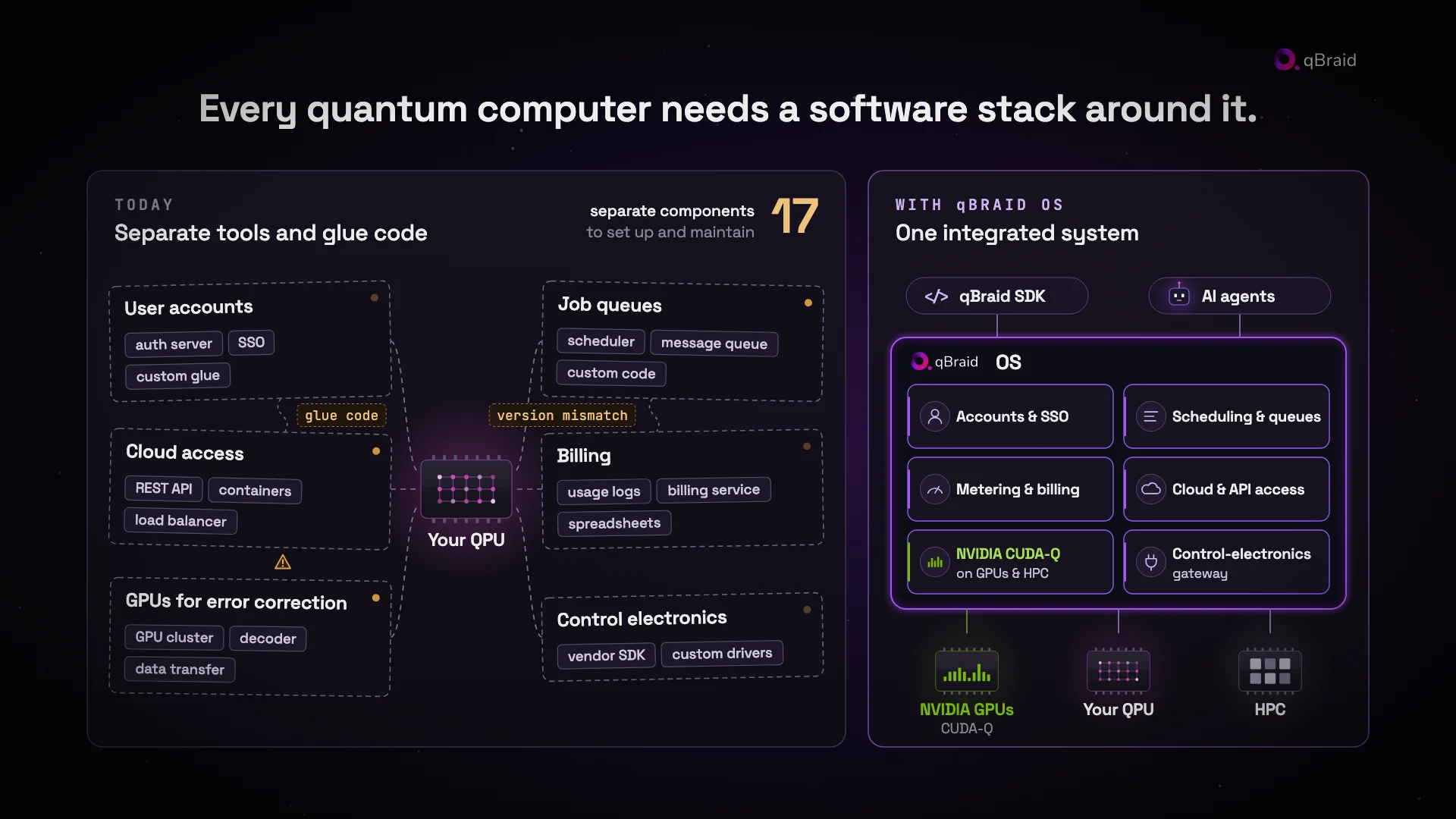
Before anyone can run on a quantum computer, it needs accounts, queues, billing, a cloud API, GPUs for error correction and drivers for its control electronics. Companies building or operating quantum computers typically develop this themselves.
 (opens the full-size image in a new tab)
Figure 1. Before and with qBraid OS: separate tools and glue code around the processor, replaced by one integrated system.
Each company assembles the stack from separate tools and glue code, and maintains it alongside the hardware.
Accounts, scheduling, metering and billing, cloud access, the CUDA-Q platform on NVIDIA GPUs and the control-electronics gateway arrive as one system.
The same infrastructure qBraid built and runs for its own agentic platform, which provides access to systems from 18 hardware providers.
Each part replaces software a hardware team would otherwise build and maintain itself. Together they run a quantum system for its users.
Setup and operation designed to be carried out with AI agents, within permissions set by the operator.
Connect through the processor's existing interface, or directly to the system's control electronics.
Schedule quantum processors and NVIDIA accelerated computing together, including systems connected through NVIDIA NVQLink.
Designed to leverage NVIDIA accelerated computing alongside the processor through CUDA-Q, for quantum error-correction decoding and classical processing during each job.
User management, reservations, usage metering and billing, for a commercial service or for internal use.
The qBraid SDK, qBraid AI agents and NVIDIA CUDA-Q, with the same code developers write for other qBraid hardware.
Defined interfaces for compilers, optimizers, error-mitigation tools and resource-estimation services, so each integrates once.
From a hardware company's own lab to a supercomputing center, alongside GPU and HPC systems.
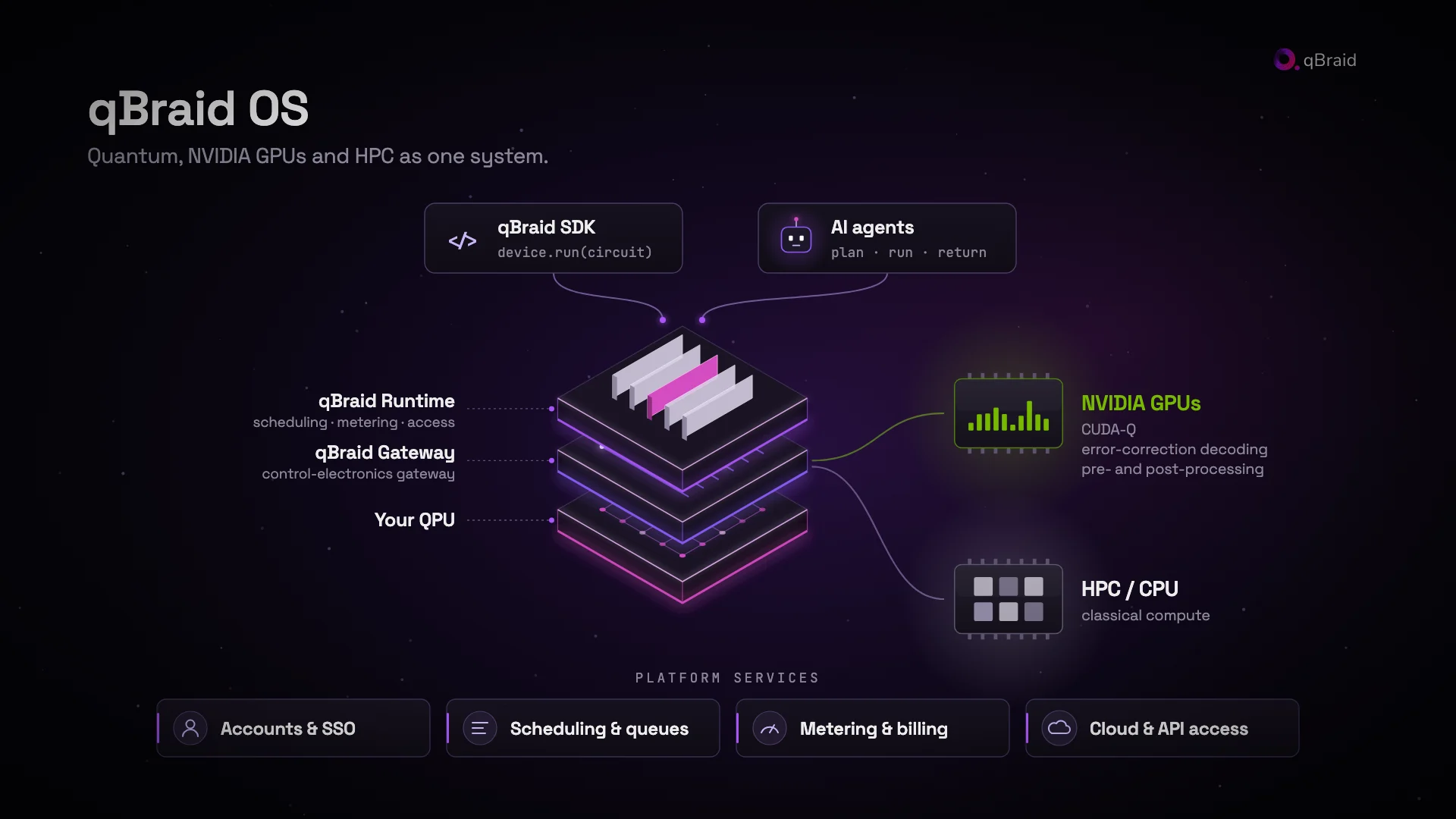
qBraid OS combines qBraid Runtime and qBraid Gateway around your processor, and runs it with NVIDIA accelerated computing under one scheduler.
 (opens the full-size image in a new tab)
Figure 2. qBraid OS architecture.
How developers and agents reach the system. A program calls device.run(circuit); an agent plans, runs and returns results.
Scheduling, queues, metering and access, from qBraid Runtime.
The connection to the hardware, through its processor interface or its control electronics, from qBraid Gateway.
The system you built or operate, in your own lab or at a supercomputing center.
Quantum error-correction decoding and classical processing during each job, through the NVIDIA CUDA-Q platform, scheduled together with the processor, including systems connected through NVIDIA NVQLink.
Classical compute scheduled together with the quantum processor, on premises or in the cloud.
Developers reach a system on qBraid OS through the qBraid SDK, qBraid's AI agents and NVIDIA CUDA-Q, with the same code they write for other qBraid hardware.
from qbraid.runtime import QbraidProviderprovider = QbraidProvider()device = provider.get_device("your-qpu") # your system's device IDjob = device.run(circuit, shots=1000)print(job.result().data.get_counts())import cudaqcudaq.set_target("qbraid", machine="your-qpu")@cudaq.kerneldef bell(): q = cudaq.qvector(2) h(q[0]); x.ctrl(q[0], q[1]); mz(q)print(cudaq.sample(bell, shots_count=1000))qBraid is used by more than 35,000 developers from over 1,700+ companies and around 1,200 universities, in more than 120+ countries. A system offered on qBraid appears next to the hardware they already use.
Defined interfaces let compilers, optimizers, error-mitigation tools and resource-estimation services connect to qBraid OS a single time.
qBraid OS can be deployed from a hardware company's own lab to a supercomputing center, where the processor runs alongside GPU and HPC systems on premises.
Open to developers on qBraid
Metering and billing built in
SDK, CUDA-Q and AI agents from day one
Private to your researchers
The same scheduling, GPUs and agents
Billing off
qBraid OS is available now to early-access partners. Tell us about your system and how you plan to operate it.