
Introducing qBraid OS: the software around the quantum processor
Berlin, NVIDIA GTC Berlin — October 21, 2026 — Today we are introducing qBraid OS, software that quantum hardware providers and system operators use to run their systems and make them available to users, whether as a commercial service or for internal use.
qBraid OS manages access, scheduling and billing for a quantum processor, and runs it together with NVIDIA accelerated computing, on premises or in the cloud. It uses the NVIDIA CUDA-Q platform to weave quantum processors together with CPUs and GPUs.
The problem: the software around the processor
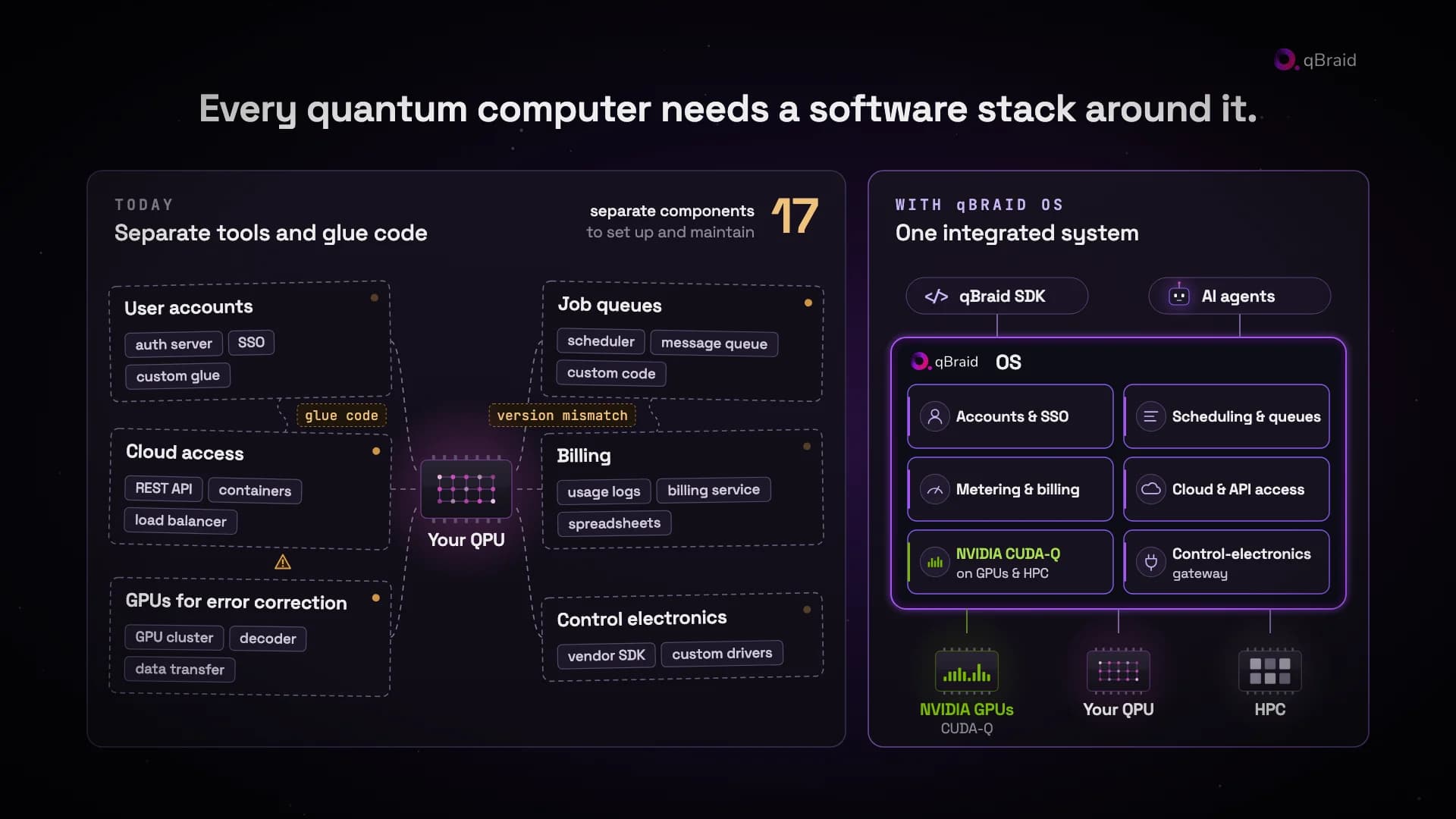
A quantum computer is only useful once people can run on it. Before anyone can, the system needs a layer of software around it: user accounts and sign-in, job queues and a scheduler, usage logs and billing, a cloud API, GPUs for error-correction decoding, and drivers for the control electronics.
Companies building or operating quantum computers typically develop this software themselves, alongside the hardware. Each piece is built separately and joined with glue code, and each needs to be maintained as the hardware changes.
qBraid OS replaces that stack with one integrated system. It is based on the infrastructure we have built and operated for our own agentic platform, which serves thousands of quantum developers and provides access to systems from 18 quantum hardware providers.
How it works
qBraid OS sits between a quantum processor and the people who use it. It brings together qBraid Runtime, which handles scheduling, metering and access, and qBraid Gateway, which connects to the hardware. NVIDIA accelerated computing runs alongside the processor under the same scheduler.
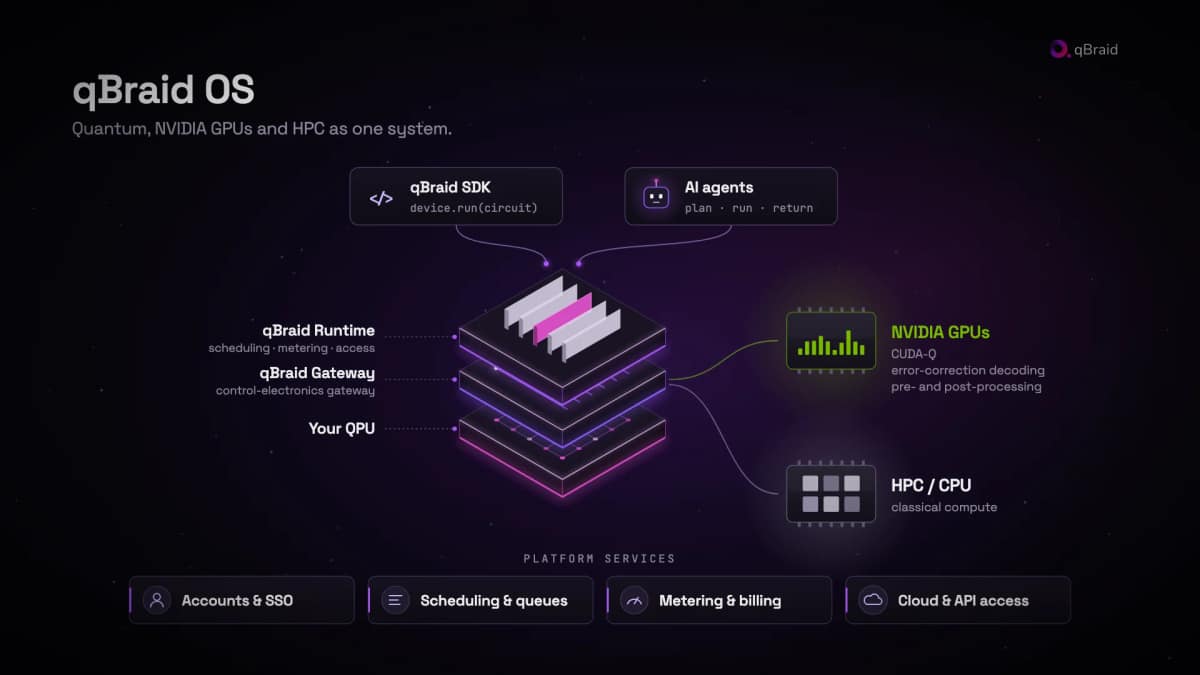
qBraid OS is designed to leverage NVIDIA accelerated computing alongside quantum processors through the NVIDIA CUDA-Q platform, to allow quantum error-correction decoding and classical processing during each quantum job. Because qBraid is a supported CUDA-Q provider, systems running qBraid OS can be made available to developers through CUDA-Q.
Key capabilities include:
- Connect any system. Connection through an existing processor interface, or directly to a system's control electronics.
- Hybrid scheduling. Combined scheduling of quantum processors and NVIDIA accelerated computing, including systems connected through NVIDIA NVQLink.
- Operate as a service. User management, reservations, usage metering and billing.
- Agent-run operations. Setup and operation designed to be carried out with AI agents, within permissions set by the system's operator.
- Developer access. Developers use the qBraid SDK, qBraid's AI agents and NVIDIA CUDA-Q, with the same code they write for other qBraid hardware.
- Integration points. Defined interfaces for compilers, optimizers, error-mitigation tools and resource-estimation services, so each needs to integrate only once.
Who it's for
qBraid OS is for companies that build quantum computers and for the organizations that operate them.
A hardware company can use it to offer its system to customers, with metering and billing in place and developers able to reach it through the qBraid SDK, AI agents and CUDA-Q from the first day. A research lab or supercomputing center can use it to run a system for its own users, with the same scheduling, GPUs and agents and billing turned off.
qBraid OS can be deployed wherever a quantum computer is installed, from a hardware company's own lab to a supercomputing center, where the processor runs alongside GPU and high-performance computing systems on premises.
“Companies building quantum computers should be able to spend their time on the hardware,” said Kanav Setia, CEO of qBraid. “qBraid OS gives them the software we have built and run for our own platform, connected to NVIDIA accelerated computing, so their systems are ready for users sooner.”
“Quantum processors and GPU supercomputers will become as easy to use together as CPUs and GPUs are today,” said Sam Stanwyck, Director of Quantum Product at NVIDIA. “qBraid OS builds on NVIDIA CUDA-Q and NVQLink to help hardware providers offer their systems as services, giving developers and AI agents a consistent way to access quantum hardware and run unified workflows.”
Availability
qBraid OS is available now to early-access partners. Quantum computing companies can learn more and request access at qbraid.com/qbraid-os.
About qBraid
qBraid is an agentic cloud orchestration platform for quantum computing, used by more than 35,000 developers from over 1,700 companies and around 1,200 universities in more than 120 countries. It provides access to quantum hardware from 18 providers, NVIDIA GPUs and AI agents in one environment. qBraid is headquartered in Chicago. Learn more at qbraid.com.
Media contact: contact@qbraid.com
Read the press release: qBraid Announces qBraid OS for Operating Quantum Computing Services. Learn more about qBraid OS.